.svg)


Government rode “roughshod” over environmental laws in Yntegra approvals
Court told of secret permits, stakeholders forced into a “treasure hunt” for documents, and a single resort proposal “salami-sliced” into pieces to hide its full environmental impact
The government has “ridden roughshod” over the country’s environmental laws by approving parts of the Yntegra project insecret, leaving neighbours and the public unable to take part in proper consultation, the Supreme Court heard.
Fred Smith, KC, for neighbouring property Turtlegrass, said key works – including controversial activities such as seabed dredging – were approved before the wider public knew they had even been applied for. “Some CECs were granted with incomplete consultation, others allegedly in secret or with no consultation at all,” he said.
“Neither the applicant nor Over Yonder Cay nor any consultees knew anything about what was going on,” he said. “And they were being consulted, allegedly, in relation to the entire project.”
The judicial review challenges two Certificates of Environmental Clearance (CECs) granted by the Director of Environmental Planning and Protection to developers Yntegra, and seeks declarations that two earlier certificates were unlawful. A second claim challenges the Director’s extensions of one of those certificates after it had expired.
In August 2024, the Director issued CEC 2400, allowing land clearing and dredging for a dock in North Bay. It was, Mr Smith said, “applied for, no consultation, and issued without reference to stakeholders.” Turtlegrass said it allows for roads to be cleared throughout the whole of East Sampson Cay without any environmental impact assessment.
The certificate itself hid the scale of the works. “Even had CEC 2400 been produced, nobody would have known what work swere entailed,” Mr Smith said.
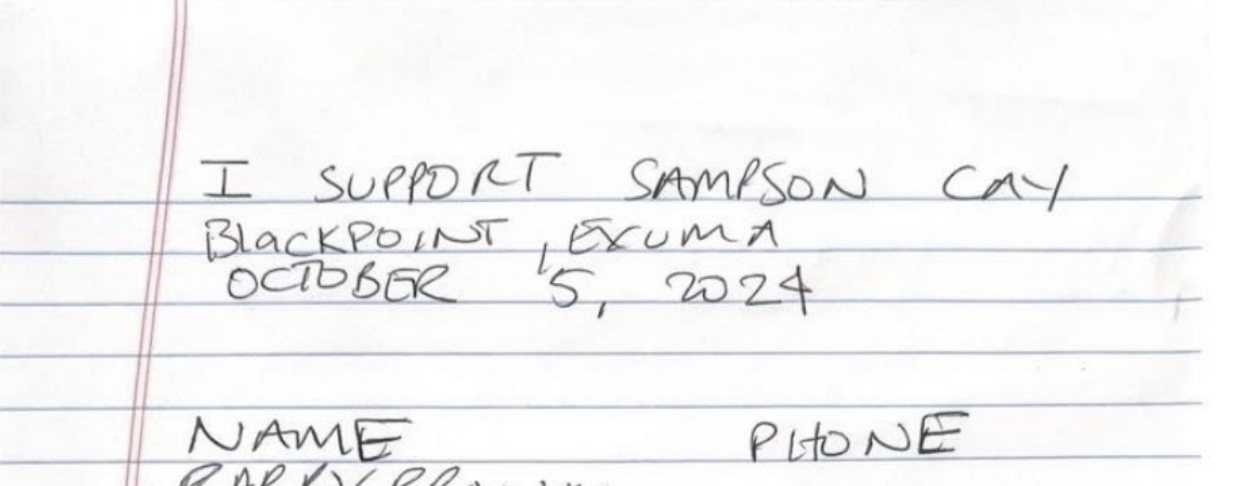
On October 3, residents attended a public meeting on the project, unaware that major works had already been approved. "Consultees were not told that key elements of the proposed development had already been approved pursuant to CEC 2400," Mr Smith said. Five days later the Department revoked that certificate and replaced itwith CEC 2400A, issued without any application at all.
Peter Village KC, also for Turtlegrass, called this an "extraordinary irony." "It was completely unbeknown to anyone that that application had been made," he said. Turtlegrass's case is that the meeting, held on an entirely different proposal, gave the Department an unplanned reading of public opinion. Having seen by chance how unpopular the approved works would be, the Department amended its secret certificate before the public ever learned of it.
Two more certificates followed in June 2025, including CEC 2884 for a workers’ camp that the Director herself had prompted the developers to apply for.
CEC 2400A, which expired in October 2025, was later extended twice without consultation, which Turtlegrass maintains was unlawful. Mr Smith said the only lawful course was “a fresh application and fresh consideration.” Extending the permit without “fresh consultation, transparency” was, he said, “irrational, procedurally unfair, or for an improper purpose.”
Those who were consulted were denied the information they needed, Turtlegrass claims. The first EIA and the Environmental Management Plan were never published, leaving stakeholders on a“treasure hunt” that made consultation “unwinnable.”
“Neither EIA revision 2 nor the consultation report nor any version of the EMP were made available to the public prior to the issuance of the CECs,” Mr Smith said. The northwest tip of Big Sampson Cay was never put to consultation at all. After consultation closed, the seawall was lengthened to project some 390 feet into North Bay, and the public was never consulted again. This, Mr Smith said, “breached the EPPA objective of minimising environmental harm through public consultation.”
Key documents surfaced only in July 2025, after Turtlegrass’s attorneys wrote twice to the Director. Only then did she tell them the documents were “within the public domain” on Yntegra’s website. The revised EIA, the management plan and two of the certificates, Mr Smith said, “were not made public until, one, long after the consultation period had closed, and indeed, two, after all the CECs had been granted.” Neither the Department nor the developers had published them before, he said.
“This JR is not and cannot be an ongoing consultation to try to remedy afterwards what was not done prior to the issue of the CECs,” he said.
Mr Smith said the developers had not even kept within the approvals they did receive.
“What we see, my Lord, very shortly, is that just in addition to Turtlegrass’s complaints of a failure to properly consultand disclose relevant and important documentation, and as your Lordship knows from the injunction applications and debates that we’ve been having, the developers are not even abiding by the permits that they were able to obtain in secret,” he said. “And their position has been that they are entitled to do these works without any other regulatory approvals.”
He said the Director’s letter of August 25, 2026, ended up “shutting them down from all the works that they’ve been conducting, the mass clearing on the southern tip of East Sampson Cay.”
CEC 2400 banned “mass clearing,” yet the developers’ original application for the whole project had proposed clearing 50 per cent of the existing vegetation.
Mr Smith said the Heads of Agreement with the Government describe one project requiring a single assessment, yet it was approved in fragments. That same agreement promised a resort that would“minimise impact on the ecosystem.” “Splitting it like this is a classic example of salami slicing,” he said. “It was unlawful to grant CECs for parts of the development without proper public consultation.” The splitting, he said,deprived Turtlegrass and Over Yonder Cay of the chance to assess “what a combined project would have on their properties and on the environment.”
Turtlegrass also says the developers disregarded their own undertakings on protected trees. The application for CEC2400 said they had worked with the Forestry Unit “to secure a permit to harvest protected trees” and would survey the land to “identify protected flora” before any clearing, and the original application for the whole project promised to steer heavy equipment “to avoid impacting protected trees where possible” and to replant three trees for every one removed. The Forestry Unit’s permit, Mr Smith said, “required the nursery to be off-site, not anywhere on the property,” yet CEC 2884 approved one alongside the workers’ camp. In any event, the photographs and video from the injunction hearing showed “there was no nursery and there was this widespread clearing of land without regard to the trees, the protected trees.”
Parliament, Mr Smith said, had gone “to great lengths” in the Environmental Planning and Protection Act and the Protected Species Act to protect the environment. The Director, he said, “has an obligation first and foremost to protect the environment… and to mitigate as much as possible damage to the environment.” The Act, he said, is “founded onthe principle of the protection of the environment of The Bahamas, including its ecological integrity and effective public participation in decisionmaking.” And “the grant of a CEC does not mean that a project entails no environmental harm, but rather that the harm is considered by the director acceptable.”
Mr Village told the court that public participation is “the golden thread” of environmental law, appearing in “four separate places in this legislative scheme, each independently requiring the same thing.” “It’s not simply that consultation is procedurally convenient,” he said. “The public’s participation is what is meant to drive environmental improvements in the first place.”
“It is perfectly clear that the Department of Environmental Planning and Protection has turned its back on those principles,”he said. “It has eschewed them.”
“Transparency matters,” Mr Smith told the court, adding that “stakeholders, the public, and neighbours” matter too. “Proper consultation in accordance with the law, the legislation, and the rules, and of course, the common law, matters. The environment matters to The Bahamas now. So, in effect, the environment is a party to this case.”
Latest Blog