

Water expert slams Yntegra EIA for failing to properly assess risks
“No evidence of any on-island investigations having been undertaken”
High level summary:
- Hydrogeologist Clive Carpenter reviewed the groundwater and hydrology in Yntegra’s environmental study, found it “fails to assess to any sufficient or proper degree the groundwater and hydrological environments of Sampson Cay.”
- The Yntegra EIA relied on a 2004 US Army Corps study built from “large scale” national maps that are “not island specific.”
- A proposed resort this large must run a desalination plant and produce brine that is much saltier than the sea. Yet “the issue of brine disposal is completely omitted from the EIA.” The one idea floated, pumping it into a wetland, “raises serious concerns” about brine sinking into the groundwater and flowing to the ocean.
- The desalination plant, wastewater plant, fuel tanks, generators and waste storage would be “no more than 50 to 100 feet from the high tide mark,” served by a 6,000-ft fuel pipeline with “no mention of containment structures, bunds and leakage detection systems.” A fuel leak “could pollute the groundwater flows to the coast for many years,” Carpenter warns.
- The Yntegra EIA treats the island’s freshwater as scarce or absent. However, in his own assessment in June 2026 Carpenter found fresh groundwater on Sampson Cay - strongly suggesting “the sensitivity and vulnerability of the groundwater resource... is significantly underestimated by the EIA.”
Turtlegrass is publishing a series of expert witness reports on the Yntegra Group’s proposed Rosewood Exuma resort on Sampson Cay. Each was prepared by a highly qualified specialist for the legal proceedings now before the courts, and we are releasing summaries so the public can see what the evidence says. At the end of this article, you’ll find links to the other reports as well.
In this fourth report, Clive Carpenter of GWP Consultants, an independent hydrogeologist, has reviewed the environmental study behind Yntegra's Rosewood Exuma resort. He finds it "fails to assess to any sufficient or proper degree" the groundwater and hydrology of Sampson Cay. It omits elements that should be included, cursorily reviews others, and as a result, inadequately assesses the impacts and risks raised by the project. The most basic failing from a hydrology and groundwater point of view is that no one appears to have investigated the actual island, instead relying on another study from 2004 that itself drew on old data that was not specific to Sampson Cay.
Who is Clive Carpenter?
Carpenter is a hydrogeologist with GWP Consultants and has more than 33 years of experience in groundwater, surface water and flood risk. He holds a BSc (Hons) in Geology from Bristol and an MSc in Hydrogeology and Groundwater Resources from Birmingham, and has spent more than 25 years working on water resources, flood risk and climate resilience in Small Island Developing States.
He is a Fellow of the Geological Society, a Chartered Geologist, a Chartered Member of the Chartered Institution of Water and Environmental Management, and a former Secretary of the British Chapter of the International Association of Hydrogeologists.
Crucially, he knows these islands. He has just completed a three-year assessment of The Bahamas' national water sector - water resources, supply, wastewater and drainage - including groundwater and water-supply systems in Exuma, and has worked across New Providence, Andros, Abaco, Eleuthera, San Salvador and Acklins, as well as the wider Caribbean and dozens of other island states.
In short, assessing how water moves through small islands, and where pollution goes with it, is his specialist field.
What he was asked to assess
Carpenter was instructed by Callenders & Co., on behalf of Sampson Cay Retreat Limited, to review the groundwater and hydrology parts of Yntegra's Environmental Impact Assessment (EIA) - the study DEPP relied on when it issued the project's environmental clearance.
His brief was focused and technical: the risks of pollution to the island's underlying groundwater from wastewater, storm-water run-off and accidental spills; the changes the development would make to rainfall run-off and flood risk; and the effect on groundwater of relocating the island's wetlands. His concern is the water beneath and running off the island, and whether the Yntegra EIA understood where that water - and anything it carries - actually goes and therefore fully appreciates the pollution and other risks that might arise from the project. He did not assess marine ecology, seagrass, coral or wildlife - those are covered by other experts in the series.
The central finding: the Yntegra EIA "fails to assess to any sufficient or proper degree"
Carpenter's conclusion is unsparing. His review "concluded there are significant failings in the adequacy of the EIA on the matters of groundwater and hydrology impact" - failings that "include omission of some impacts and little more than preliminary environmental screening of others, with no further analysis" (pg. 1).
His overall verdict? "I conclude the EIA fails to assess to any sufficient or proper degree the groundwater and hydrological environments of Sampson Cay and therefore does not adequately identify and evaluate the impacts of the proposed development" - not only on the island's water, but on "the coastal-marine environment the groundwater and hydrological regimes discharge into" (pg. 21). Where such impacts are unacceptable, he writes, that finding "should have informed either design of risk reduction measures or, where risk mitigation is not possible, then relocation or removal of the proposed development as a pollution risk" (pg. 21).
An assessment built without ever studying the island
Carpenters finds that the most basic failing from a hydrology and groundwater point of view is that no one appears to have investigated the actual island. In his words, Yntegra’s EIA offers “no evidence of any on-island groundwater or hydrological inspections, surveys or investigations having been undertaken”. What the EIA leaned on instead for this portion of its assessment was a US Army Corps of Engineers study from 2004 that "used pre-existing documents and did not undertake site specific investigations across the archipelago," drawing on "large scale" national maps that are "not island specific" (pg. 11).
Carpenter finds "inadequate characterisation of the groundwater and hydrological (surface water) regimes," with the baseline assessment limited "to a review of non-island specific literature documents."
The EIA, he writes, "does not present any data or information to demonstrate there has been any groundwater hydrogeological investigation on Sampson Cay," and shows "no attempt to characterise, let alone the geometry of possible freshwater lenses on the island" (pg. 11).
Proper byproduct brine disposal "completely omitted" while one idea floated “raises serious concerns”
A resort of this size would run a desalination plant to create freshwater, and desalination produces brine. This is water far saltier than the sea - typically one and a half to two and a half times as saline. Disposing of it safely is a serious engineering problem yet Carpenter finds the EIA barely acknowledges this issue exists. “The issue of brine disposal is completely omitted from the EIA," he writes (pg. 9).
Carpenter finds "no mention of desalination brine in the EIA, no mention of quantities, flow rate or expected water quality and salinity, and most obviously no mention of how it will be disposed."
The one idea the documents do float is pumping the brine into a new inland wetland to create hypersaline conditions. Carpenter warns this "raises serious concerns about the impact on surrounding groundwater given the brine is unlikely to be contained and retained solely within the wetland" (pg. 1). Being denser than seawater, the brine would sink into the groundwater beneath the wetland "significantly increasing its salinity, and from there flowing with the groundwater to the coastal-marine environment immediately (within 100 feet) to the south-west" (pg. 14).
Freshwater was assumed nonexistent - leaving the resort’s impact on it “not properly understood”
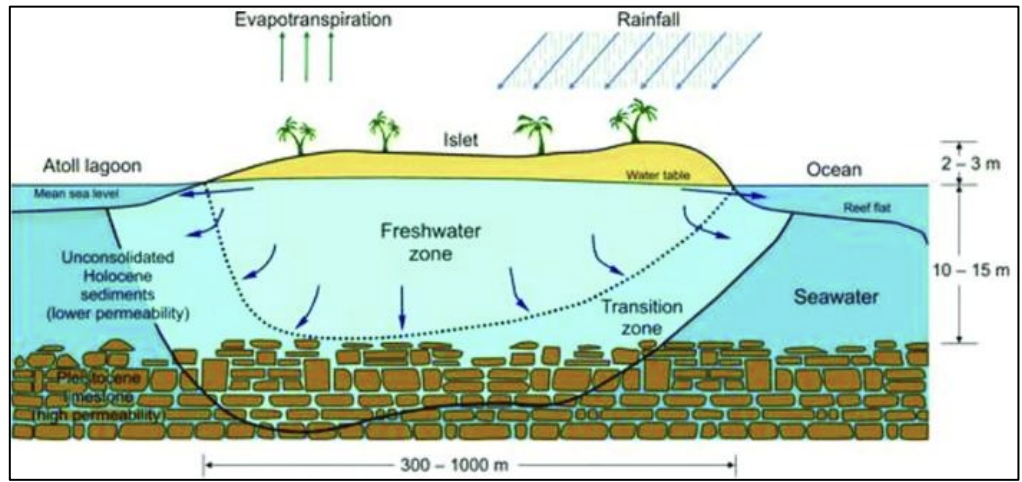
The EIA treats the island's freshwater as scarce or absent and underestimates the pollution risk too. Meanwhile, Carpenter's own testing on 18 June 2026 measured fresh groundwater on the Turtlegrass estate, on the western side of Sampson Cay, at 1,047 microsiemens per centimetre some 300 feet from the coast (pg. 7). East Sampson Cay, where Yntegra's resort would sit, is immediately adjacent, with "near identical geology, island size and proximity." Carpenter concludes, "there is in likelihood areas of freshwater groundwater resources also on east Sampson Cay" (pg. 20).
The consequence is serious: "the sensitivity and vulnerability of the groundwater resource on the development site is significantly underestimated by the EIA and hence the impact also underestimated and not properly understood" (pg. 1).
Potential for groundwater to carry pollutants to the ocean not studied
Groundwater on a low island flows outwards and downwards to the coast and can carry whatever is dissolved in it into the sea, creating “a pathway for contaminants to the coastal-marine environment". Yet the EIA never acknowledges this.
The EIA's own Summary Impact Table even flags the groundwater as being at high or moderate risk from marina excavation, dredging, spills and waste, yet the analysis stops at that screening-level flag and goes no further (pg. 11).
Pollution sources placed within feet of the shoreline
Much of the resort's dirtiest infrastructure would be concentrated in a single "Back of House" compound at the north of the island: the desalination plant, the wastewater treatment plant, fuel tanks, generators, a boat workshop and solid-waste storage. These facilities, Carpenter notes, would sit "at their nearest no more than 50 to 100 feet from the high tide mark" (pg. 9).
Fuel is the biggest worry. Hydrocarbons "are very persistent chemicals," he writes, and if they reach the shallow groundwater "they could pollute the groundwater flows to the coast for many years. This risk has not been adequately assessed in the EIA" (pg. 13). Given how close the tanks and waste sit to the water, undetected leaks would have "minimal migration times to reach the immediate nearshore coastal environment" (pg. 13).
A fuel pipeline is proposed to run the entire 6,000-foot length of the island, with "no mention of containment structures, bunds and leakage detection systems in the EIA" (pg. 11).
Wetland “relocation” and flood risk questioned
The EIA itself recognises that removing two southern wetlands will strip out natural flood storage, yet, Carpenter notes, it does "not identify how this flood risk will then be mitigated" (pg. 2).
The wetland relocation plan floated by Yntegra has similar challenges, he finds. Their baseline hydrology "has not been assessed," so the EIA "cannot therefore justifiably conclude that relocating the wetlands will ensure their survival" (pg. 2) - moving salt- and freshwater habitats to ground whose water quality nobody has measured.
He also notes that the removal of these wetlands “will increase storm run-off, erosion and sediment mobilisation into the coastal-marine environment in that area”.
A particular concern is whether storm water and wastewater would be combined for treatment and disposal - something the EIA leaves "unclear" and even "contradictory" (pg. 10). If they are mixed, Carpenter warns, "it is inevitable there will be storm overflows of untreated wastewater either discharging into the disposal wells or escaping from the plant itself" (pg. 10). Raw sewage, in other words, forced out during the very storms the island is most exposed to.
When it comes to flooding, there has been "no baseline flood risk assessment undertaken," and "consequently, this has not informed the layout of the proposed development" (pg. 20). Drainage is proposed but not detailed (pg. 17).
Yntegra documents “do not adequately assess the impacts and risks.” Here’s what should have been required
On the evidence put before DEPP before it granted environmental approvals to Yntegra for its Rosewood Exuma project, the groundwater was never studied, the freshwater resource was assumed away, brine disposal was left out entirely, and the single most important question - how pollution on the island would travel to the sea - was never asked. As Carpenter sums it up, there are "serious omissions in the groundwater and hydrology impact assessments of the EIA," and the impacts that are included "are only considered in a superficial way, and do not adequately assess the impacts and risk" (pg. 21).
Carpenter is clear about what his expertise tells him should have happened before any clearance was granted. He "would have expected the groundwater regime to be investigated - necessitating the drilling and monitoring of test boreholes, permeability testing, salinity and water quality testing across the island," so that the pathway from pollution sources to the sea and the wetlands could actually be understood (pg. 16). Had that work been done and the impacts judged unacceptable, it "would have informed either design of risk reduction measures or, where risk mitigation would not have been possible, the relocation or removal of the proposed development as a pollution risk" (pg. 16).
This is the latest in a series of expert reports Turtlegrass is releasing on Yntegra's Rosewood Exuma project to ensure the public is fully informed about what is being proposed and to demonstrate the issues raised by the granting of environmental approvals to the project on the basis of the information submitted by Yntegra. The first two came from ecologists who reviewed Yntegra’s paperwork - Andrew Baker, who called the Environmental Impact Assessment “deeply flawed” and ornithologist Mark Gash, who went through the same material and reached the same conclusions, calling the EIA “wholly inadequate”. For the third report, Dr Craig Dahlgren got in the water and surveyed the North Bay himself.
Read Carpenter's full report for yourself, and watch for the rest.
Previous reports:
- Marine Scientist Warns: Proposed Rosewood Exuma Dredging Would Destroy 1.6 Acres of Healthy Coral Reef
- An expert found Yntegra's environmental case for Sampson Cay "wholly inadequate."
- “Deeply flawed”: An environmental expert takes a deeper look into Yntegra’s Rosewood Exuma project